Monday, July 6, 2009

A Counter Pose for "Head-to-Knee Pose"

"Three-Limb Pose" or Triang Mukhaikapada Pachimottanasana
America just celebrated its 233rd year of freedom this past weekend! Living in a free country with the ease of movement from place to place contributes to our joy and happiness when we pause long enough in one place to appreciate it. We can also experience this joy and freedom of movement in our bodies, minds, and even spiritually, when we practice yoga with a clear intent to move freely and fluidly with frequent and meaningful pauses.
Be sure to schedule plenty of time for this practice so that these pauses in stillness can provide time to appreciate each place we're in at the moment! They also give our muscles and joints an opportunity to loosen and relax in each transitional phase of the postures. L
ast week's "Head-to-Knee Pose" encouraged an external rotation (away from center) in the hip joints one side at a time. So this week as you practice the internal rotation of a counter pose that encourages greater range of motion in both directions---inward and outward---"Three--Limb Pose" (Triang Mukhaikapada Paschimottanasana,) remember to pause and notice the internal (toward the center) rotation in each hip joint. Warning: Students with knee or hip injuries or replacements should consult their physician before attempting this intense stretch of the knee joints. All students should proceed with caution! Be truthful about the limitations of your body and patiently practice several days a week without specific physical expectations... other than releasing tension.
  • Physically---Begin this "three-limb" seated forward bend in the pose called "Staff Pose" (Dandasana) seated on a level spot, either in or out -of-doors, with both legs extended straight out in front though flexed feet. Inhale and sweep the arms out to the sides and up to an "Upward Salute," stretching the crown of the head and the spine upward as the "sit bones" are pressing back and downward to ground into a blanket, towel or yoga mat. During the long and slow exhalation roll onto the left "sit bone" and bring both hands onto the floor beside the hips as the right leg bends at the knee. Rotate the right thigh internally toward the center to touch the inner left knee with the right foot pointing toward the back along side of the right hip. Pause here to notice if the hips are level and if there is pain or extreme discomfort in the right knee. The intensity of this stretch can be reduced by sitting on a folded towel or blanket, or even a low chair with the right foot pointing backward and gently pressing onto the top of the foot and the left leg stretched straight out from the hips and pressing through a flexed left heel. Never stay in a position that causes shooting pain or extreme discomfort!
  • If the right knee is particularly tight, the left hip will drop and feel lower but it can be brought into a level and balanced position by placing a folded towel or blanket under the lower hip and "sit bone." The calf of the bended leg may also be smoothed away from center with the thumb and forefinger in an ironing motion. Sit and pause in this "Three-Limb" position for 3-5 smooth and even breaths before attempting to add the forward fold that stretches the spinal muscles and the back of the extended leg. Allow time for the right hip to relax in internal rotation.
  • Then on another long, slow and deep inhalation sweep the arms upward while drawing the tail bone back away from the heel of the extended leg. Gently exhale the torso into a forward fold by hinging from the hips only, and then clasp the hands or wrists over the ball of the left foot, or loop a belt or strap over that foot to use as leverage. Stretch only to the very first sensation of resistance in the spine, hip or hamstring before you stop and pause for a breath or two. Allow the muscles and joints to soften and expand before moving to deepen the forward bend to a new "edge." Continue to move freely and fluidly without pulsing or jerking quickly to bring the abdomen onto the upper thigh of the extended leg. Pause to breathe smoothly and deeply into each perceived tightening of muscle or joint and the appreciate the sweet release. Feel the compression across the abdominal organs as you allow the abdomen to expand against the upper thighs with each inhalation. Now exhale the chin toward the lifted chest and feel the connection between the base of the tail bone and the top of the neck. Inhale to roll slowly up from the base of the spine by pressing the inner knees down and together as the hands slide along the legs, and then sweep the arms up along with the gaze.
  • To switch sides exhale back onto the "sit bone" of the extended left leg, and then slowly straighten the right leg to return to "Staff Pose." In order to repeat "Three-Limb Pose" on the opposite side. inhale onto the right "sit bone" and bend the left knee to place it alongside of the right inner knee with an internal rotation of the left hip.
  • Mentally---Maintain focused attention on the gentle stretching sensations experienced in the back, hips and thighs during each inhalation. Consciously choose to release all affected muscles and joints during and through each exhalation. Decide that you are going to enjoy remaining in each phase of the pose for 3-5 breaths without thinking or rushing ahead to the next stage. Stay present with the breath and the body, temporarily putting aside all emotional responses to each phase of the position. Free yourself from expectations and goals as you enjoy just being truthful to yourself in your version of the pose.
  • Spiritually---When practicing intense poses such as "Three-Limb Pose" remind yourself of the freeing nature of knowing and accepting the truth. Jesus said it best, " And ye shall know the truth, and the truth shall make you free." (John 8:32, KJV) Enjoy your newfound freedom in the pose physically as you take time to release mentally and spiritually. plf

Monday, June 29, 2009

Relaxing into Submission

"Head-to-Knee Pose" or Janu Sirsasana
We all know how important it is to relax. We take vacations to relax. And yet sometimes we're so busy moving around from place to place, sightseeing, shopping, etc. that we forget to stop and do nothing but relax. The word "relax" stems from two Latin roots meaning to go back (re) and to loosen (lazare). When we use yoga to relax we're literally taking our physical body and our mental activity back to the loosened state they were in as a child, and then taking the time to rest (or remain) there. Remember how we could sit on the floor and play for hours in different seated positions without becoming tired? Let's approach the seated position called "Head-to-Knee Pose" or Janu Sirsasana with the intent to go back to a loosened state---in our spine, our hips, our legs and our mind---to find a resting place of ease and comfort. During warm weather it can be very relaxing to take your mat or beach towel to a quiet and private spot outside when there is flat and level terrain for grounding.

  • Physically---Before attempting "Head-to-Knee Pose" the muscles and joints in your body will appreciate a few warm-up sequences of postures such as the "Salutations to the Son," which were described in a two-part previous blog from the first two weeks in May. After completing three or more rounds of breath-synchronized movement, relax for several (3-5) easy breaths through the nose only in "Staff Pose" or dandasana as described in the blog from last week (June 22nd.) Inhale to extend the spine upward and exhale while grounding the tail bone actively away from the heels of the feet. After sitting tall in "Staff Pose" relax the abdominals and draw the tail bone back away from the heels while sweeping the arms slowly up in a seated "Upward Salute" to your Creator. While exhaling extend both arms forward to allow both hands to wrap around the lower shin of the right leg, bending the knee and drawing the flexed right foot into the base of the spine with the sole tucked slightly under the upper left thigh. Relax the right leg and knee, allowing it to release slowly toward the floor for several deep breaths. If the right hip rotators are tight they will loosen and relax more readily if the weight of the right leg and knee is supported on a thin prop such as a folded towel or pillow. Use the inhalations for spinal extension up through the crown of the head and the exhalations to release the right hip and the left hamstrings. Relax into submission!
  • There are many ways to approach this intermediate pose, but if the intent is to relax and ease into "Head-to-Knee Pose" very gradually, use props at first and hinge at the hips to fold the upper body onto a soft beach bag or folded towel resting on the extended leg. [This posture is even safe for prenatal students with the permission of their primary care physician, and with the intent to stay aware of the space necessary for growth of the fetus.] Very slowly and respectfully with a flowing arm-sweep overhead inhale to begin the movement of the head and torso toward the actively extended left leg. Actively rotate the extended leg internally (toward the center) by pressing through the inner heel and big toe while spiraling the muscles in toward the bones. As soon as resistance is experienced in the right hip joint or the hamstring muscles in the back of the left thigh, stop for several deep breaths and allow the tissues time to loosen and relax. Then continue to extend the upper body and head out over the extended leg, lowering and surrendering into a prop to support the body weight with each exhalation. Only when the spine, muscles and joints have fully relaxed into submission are you ready to slowly remove the prop to extend the head out over the knee of the active leg with a mindfully active forward tilt of the pelvic basin. This may take several minutes, or several days, or even weeks of regular practice (abhyasa.) Some of you may even be able to grasp the big toes with the "yoga toe hold" by separating each big toe with the first two fingers of the respective hand and then lightly wrapping the thumb over those two fingers. Some of you will want to progress slowly by using props for leverage such as a strap, belt, tie, scarf, etc. wrapped over the ball of the foot and held to gently draw the body forward by widening the elbows outward to the sides. Move slowly and easily without forcing the body.
  • To reverse sides while remaining loose, stabilize the "sit bones" into the ground while engaging the pelvic floor and abdominal muscles to support the lower back. Inhale and roll up from the tail bone through the lower back to the thoracic back, and finally the neck. Finish the inhalation by looking up to reverse sides and then exhale both hands onto the lower left shin to draw the left flexed foot into the base of the spine. Stay in each phase of the pose to relax.
  • Mentally---Remain focused on using each complete breath to move deeper into the pose organically, one breath at a time. Stop even the tiniest movement until a sensation of looseness is experienced along the spine, the side body, the back of the hips and the hamstrings in the back of the extended leg. Always practice mindfully with awareness of the body and breath. Feel your body; find your breath and be consciously grateful for both!
  • Spiritually---Practice loosening all physical tension by surrendering all worries and concerns to a God who wants a connected and close relationship with each one of us. He asked us to Take time for this connection which comes through each healing breath He gives as we rest and relax in His presence, remembering Jesus' call to "Come unto me, all ye that labour and are heavy laden, and I will give you rest." (Matthew 11:28, KJV) And then again Jesus asked his apostles to "Come ye yourselves apart into a desert place, and rest a while." (Mark 6:31, KJV)
Even God rested on the seventh day after creating the heavens and the earth, and His Word tells us that we need to rest from labour: "There remaineth therefore a rest to the people of God. For he that is entered into his rest he also hath ceased from his own works , as God did from His. Let us labour therefore to enter into that rest...." (Hebrews 4:9-11, KJV)

Make time for a mini-vacation every day with God and rest in the peace of His presence.... plf

Monday, June 22, 2009

Sitting Without a Back Support

"Staff Pose" or Dandasana
Summer is conducive to sitting outside of the house or apartment, so hike to a flat rock or shady spot where you can spread out a blanket, beach towel or your yoga mat. Give yourself permission to take a break from your usual busy flurry of activity. Schedule this time to be alone with your thoughts and invite God to be part of the conversation. To be open to God's way of thinking it's helpful to pray first and then read from His Word in The Holy Bible. If this is something new and you don't know where to begin, try "The Old Testament" Book of Psalms or Proverbs found close to the center of the Bible and simply begin to read as you remain seated in "Staff Pose."

  • Physically---Because our lifestyle in Western civilization usually involves furniture to support the back, we have allowed the core muscles that support the spinal column to weaken. The seated posture called "Staff Pose" or dandasana will develop and strengthen these core muscles over time with regular practice. The discomfort of a seated position without a back to support the torso will no longer be a distraction that can impede yoking the body, mind and spirit.
  • Begin by sitting tall with the legs stretched straight out from the hips and the heels of the hands pressing into the floor by the hips, fingers spread wide and facing forward. Inhale deeply while pressing the tail bone back and away from the flexed feet in a forward tilt of the pelvic basin as the crown of the head is extending upward. Exhale and allow the chin to lower slowly toward the lifted chest into the "Chin Lock" (jalandhara bandha) as the shoulders roll down the back and away from the ears. Remain for 10-12 breaths, staying lifted and extended through the spine and chesr by pressing into the heels of the hands and grounding the "sit bones" back away from the heels of the feet.
  • Mentally---Focus the mind on conscious breathing as you become more aware and grateful of each deep inhalation, and exhale completely to release all disquieting thoughts of the past or concerns for the future. Stay attentive to smoothing the rhythm and quality of each breath.
  • Spiritually---As you sit tall in a posture that resembles a rod or staff remember the comforting words of King David's Twenty-Third Psalm, which is an extended metaphor to reveal how our God leads and cares for us as a shepherd does every single sheep in his flock. The fourth verse especially reminds us of the comfort and protection we can experience by becoming consciously aware that our shepherd is always watching over us: "Yea, though I walk through the valley of the shadow of death, I will fear no evil; for thou art with me; thy rod and thy staff they comfort me." (Psalm 23: 4, KJV)
. Begin to focus on the constant conversation that you usually carry on in your mind as you review and evaluate your life. Once reviewed and evaluated, stay in the present moment, in the presence of your God by dwelling on His ever-present loving care. "Pray without ceasing" and talk to God with softly spoken, barely audible words. Don't worry. He's always listening! plf

Monday, June 15, 2009

Open to Recognition---Now or Later?

"Garland Pose" or Malasana variation
Before practicing any particular style of yoga it would be helpful to decide your purpose or intent. Actions that spring from purpose result in a greater commitment to those actions. Do you want to become stronger, more flexible, lose weight, relieve back pain, or reduce tension? If any of these intentions in the physical realm strike a cord, there are specific postures (asanas) and sequences of poses that can lead to each of these goals. Or do you hope to gain something more ethereal, such as spiritual insight, awareness and enlightenment with a spiritual practice? Some styles of yoga place more emphasis on yogic components that enhance the spiritual journey. Or perhaps you're someone who studies with a certain instructor who will praise you for your physical capabilities in challenging postures? If the latter describes your needs, you might be someone who wants to feel accepted and even admired by others so that you receive recognition and immediate gratification here and now, in this lifetime. It's not uncommon, or even wrong, to be driven by a need to feel appreciated and even honored for success in a chosen arena. As Christians we hope to be faithful to our God, eventually receiving His praise at the last judgment when He says to us, "Well done thou good and faithful servant; thou has been faithful over a few things, I will make thee ruler over many things; enter thou into the joy of thy Lord." (Matthew 25: 21, KJV)
Personal intentions definitely influence the way we practice our yoga. As a Christian my intention in practicing yoga every day is to become so closely fastened to God with all my heart and mind and body that I will know His intent and purposes for each moment of my life. Then I desire to accomplish this with enough health and vigor to be able to teach others with similar goals and intentions how to yoke with the God of the universe in a personal, life-altering relationship. This is why I recommend the pose called "Garland Pose" (Malasana in Sanskrit) to spend time alone with God, faithfully communing with Him in prayer.

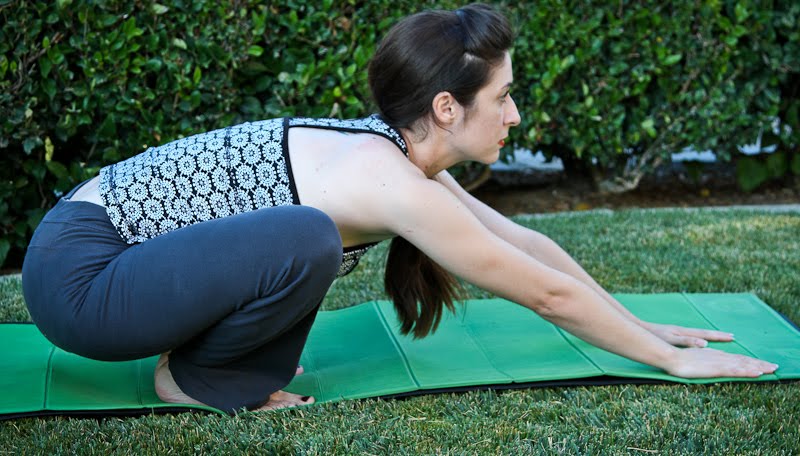
  • Physically---Exhale to lower into a squatting position on the haunches with the inner edges of both feet touching and both heels pressing down into the floor (OR pressing into a folded blanket or towel for stability.) Allow the next deep inhalation to expand the abdominal region as the arms stretch straight out from the shoulders and the torso leans forward between widening knees and thighs. Slowly exhale the straight arms to the floor in front of the body and remain in this balancing position for 3-5 deep breaths, using the inhalations to lengthen through the spine by drawing the tail bone down and away from the expanding chest. Warning: Prenatal students should remain at this stage of the pose without attempting to deepen the compression in the abdominal region for obvious reasons! For those without abdominal issues use each exhalation to further compress the sides of the abdomen by drawing the pelvic floor and abdominal muscles up and back toward the spine.  Notice how engaging these muscles called bandhas  allow the forward lean to deepen. (See the photo below for preparation.) After several minutes of quiet prayer or meditation, release one arm at a time around the front of each shin and attempt to lightly grip the back of each ankle as the forehead lowers toward the toes. Maintain the arms wrapped around the knees and shins like a garland for 3-5 smooth and normal breaths through the nose only.  Then relax onto the back in "Corpse Pose" (described in the January 24, 2009 blog) for at least 5 minutes.
  • Mentally---Focus the attention on the compression of the abdominal organs and the release of the muscles in the lower back by lengthening the spine with each inhalation. Maintain the hollow in the lower back with a deep forward tilt of the pelvic basin. Prenatal students: Focus only on the lengthening action in the lower back and the opening in the hips.
  • Spiritually---If you desire to develop a personal relationship with your Creator that will be continued into the next life, you may have to wait patiently for your crown of appreciation as you practice "Garland Pose" every day. Over a period of time if you faithfully practice this pose during prayer and/or meditation it will become more comfortable, especially as you attempt to faithfully follow the leading of the Holy Spirit's guidance for each moment. Patiently remind yourself that all rewards don't need to be seen immediately! Remember the Apostle Paul's encouragement in his second letter to Timothy: "Henceforth there is laid up for me a crown (garland) of righteousness, which the Lord, the righteous judge, shall give me at that day; and not me only, but unto all them also that love His appearing." (II Timothy 4: 8, KJV)
May each of you add a spiritual intent to deepen your yoga practice and prepare you for life after death....plf

Monday, June 8, 2009

"Couch Pose" or Couch Potato?

"Couch Pose" or Paryankasana
With summer just about two weeks away and the weather offering a plethora of opportunities outdoors, this is the season to drag ourselves off of the comfort of our couch and get the body moving. Whether we're riding bikes or horses, swimming or surfing, running or just walking amidst the natural beauty of God's creation, it feels healthy to breathe in the fresh energy (prana) found among plants and trees, or near a river, lake or one of our oh-so-spacious seas! So this week pick up your yoga mat, a blanket or a beach towel and head to a quiet spot in the great outdoors to practice "Couch Pose" or Paryankasana as you prepare to fully open your hips, your back, and your lungs.

  • Physically---Attempt to get away from the sight of all man-made objects and find a place where you can spread out your mat or blanket on a fairly soft and flat area padded by grass or sand. Remove your shoes before lowering slowly onto your knees with a long sigh of relief for having escaped the confining walls of a man-made building. Inhale and sweep the arms straight overhead while looking up toward the great expanse of sky and lengthen through the entire torso. As you exhale to sit between your feet in "Hero Pose" (virasana described in the last two blogs) be sure that the inner knees are touching with the thighs turning inward, but the toes are not sickling or curving inward but rather pointing straight behind you. Sit in "Hero Pose" with the arms extended upward for 3-5 smooth and deep yogic breaths as preparation for "Couch Pose." This transition from "Hero Pose" allows the very thick and strong group of muscles across the front of the groin (known as the psoas or iliopsoas) to lengthen and relax.
  • Then slowly exhale the arms and release the heels of the hands onto the toes with the palms facing forward, and lower carefully onto the elbows and the crown of the head. With a deep inhalation lift the chest and arch the back while pressing the tail bone down and forward in a reverse (posterior) tilt of the pelvic basin. Exhale and relax the hands outside of the thighs with the palms still facing upward and the creases of the elbows forward to maintain an open and fully expanded rib cage. Breathe deeply for 3-5 ujjayi (victorious) breaths in this transitional variation of "Hero Pose" before moving into the final "Couch Pose" called Paryankasana.
  • IF the muscles across the front of the thighs and groin have relaxed enough to keep the knees pointing toward one another and pressing down into the earth, then you may be ready to attempt the full expansion across the front and back of the body. Inhale deeply into all four corners of the lungs while raising the arms up over the head and cup each elbow with the opposite hand. Exhale the folded arms slowly and mindfully above the head while pressing the tail bone toward the knees to experience the full extension of the dorsal region, as well as the front of the body, for at least five smooth and deep breaths through the nose only. Look up or behind you (or inward at your "third eye") to enjoy each breath while in Paryankasana and marvel at the beauty of God's creation!
  • To come out of "Couch Pose" inhale the arms straight and then exhale the elbows directly under the shoulders to press back into the seated "Hero Pose." Never rush out of any yoga pose, but rather savor each slow transition. As you straighten one leg at a time out on the blanket, take time to sit and enjoy the experience of being in nature. If time allows lower into "Corpse Pose" for several minutes and deepen the joy of living in the present moment.
  • Mentally---Focus your attention on the sound and sensations of each breath as you expand your body fully in the freedom and unrestricted openness of nature. If you happen to be fortunate enough to practice "Couch Pose" on the beach, listen to the sound of each wave as it rises and then falls, trying to emulate the sibilant sound with each rise and fall of your breath. Feel all of the muscles and connective tissue in your body beginning to expand and soften as your mind is attentive to the fullness of every breath. Stay present and connected to your body, your spirit and your Creator.
  • Spiritually---Be filled with gratitude that you are able to get off of the couch and outside into God's world. No matter where you are physically or mentally, take comfort in Jesus' words: "If the Son therefore shall make you free, ye shall be free indeed." (John 8: 36, KJV)
May you enjoy each freedom that you experience....plf

Monday, June 1, 2009

More on Hero Worship

Transition #1 to elbows

Transition #2 to crown of head
These thoughts are an addendum to last week's blog on the subject of heroes. Of course there are human beings whom I admire for one reason or another, but I don't expect them to be absolutely perfect. Each of us has been given specific gifts that can allow us to become exceptional in those gifted areas, such as the contemporary female vocalist, Celine Dion, or the seventeenth century violin craftsman, Antonio Stradivari. I admire their work and recognize it as a gift from God (Romans 12:6 and I Peter 4:10), but I do not worship them as heroes or expect perfection in all areas of their lives. Why?  If we're being completely honest we'll admit that we are all flawed human beings who are subject to failures. Even our American Olympic hero with his record-breaking eight gold medals in 2008 has fallen from grace with the YouTube posting of a photo revealing Michael Phelps smoking marijuana. Disappointment due to unrealistic expectations seems inevitable, so I've learned to place my complete trust in the only perfect being who has a perfect record---Jesus Christ. This is the real reason that I acknowledge Christ as the only true hero who is worthy of worship.
When studying yoga postures and philosophy beware of placing any teacher on a pedestal of perfection that can never be maintained. Rather than judging harshly, appreciate your teachers for their strengths and accept their faults as human. Practice focusing on what is good and right in all people without setting them up in a place of high esteem that borders on worship. Develop realistic expectations of yourself and others, especially when attempting challenging yoga postures like "Lying-Down Hero Pose," also called Supta Virasana. Many positions require strength or flexibility that can only be attained through regular practice over a long period of time. Don't try to be a "yoga hero!" Move into "Lying-Down Hero Pose" gradually and respectfully with mindful awareness of your present limitations. Remember that your body is constantly changing....

  • Physically---The position of "Lying-Down Hero" is an intense stretch of the quadriceps that can be practiced anytime throughout the day to counteract the long periods of time spent in seated positions because it helps to lengthen the range of motion across the front of the body. Begin to deepen the stretch across the front of both thighs (the quadricep muscles) by exhaling slowly onto one knee at a time with the thighs rotating internally (toward the center.) Remember to use a folded blanket, towel, or even a gardening pad to protect sensitive knees, and never force the body into a posture that creates pain anywhere. Remain on the knees with the toes pointed backward and the inner knees touching for 3-5 breaths while pressing the heels of the hands into the tail bone to encourage a down and forward reverse (or backward) tilt of the pelvis to prepare for this back-bending position. On an exhalation slowly release the hips down between the feet as the arms lower and press the heels of the hands into the tops of the big toes with the thumbs pointing outward. Ground the sit bones at the base of the hips to maintain an extended spine. Inhale and lift the arms straight overhead again while lengthening through the spine, and then slowly exhale one elbow at a time directly beneath the shoulders. (See the first transition photo.) Remain in this transitional backbend for 3-5 deep breaths with the ribs expanding three-dimensionally on each inhalation and the tail bone pressing down toward the knees on each exhalation. Allow the shoulders to relax and roll down the back and away from the ears as each exhalation releases tension across the thighs and hips.
  • For those who have tight thighs and/or hips this may be as deep as you want to take this posture until the quadriceps have lengthened and relaxed over a period of time with regular practice (abhyasa.) In order to continue the deepening of the front body stretch, use each exhalation to release the crown of the head to the floor first, (See the second transition photo.) and then gradually rest the back of the head, and finally surrender the back onto the floor. Remain in each of these stages for at least three full and deep breaths, allowing the breath to take your body into a place of relaxation. Finally, IF the front of the body has relaxed sufficiently inhale both arms overhead as the tail bone presses down toward the knees and relax with the palms of the hands facing upward for several minutes. IF this "Lying-Down Hero" becomes comfortable over an extended period of practicing regularly, the elbows may bend to allow the hands to wrap around the opposite elbow for the most intense stretch to be described in next week's blog.
  • Mentally---Because "Lying-Down Hero" is such a rigorous and intense stretch across the entire front of the body, it is absolutely crucial for the mind to be present in the body during each of the transitional phases that lead to the full version of Supta Virasana. The most valuable aid in deepening any yoga posture is to use the breath organically. That is, breathe deeply into the opening stretch to a place referred to as the "edge" or place of maximum resistance before pain, and then exhale thoroughly to release tension at that edge and relax there. It's helpful to count seconds in order to lengthen the duration of both the inhalations and exhalations until they are equal in time. So if the inhalation lasts to the count of 4 or 5, the exhalations should match that amount of time. This practice also helps to keep the mind from wandering outside of the body into a past or future time by keeping it occupied on each present breath. It's also crucial to practice truthfulness (satya) while in each phase so that the ego does not tempt the body to go deeper than it's ready to go.
  • Spiritually---"Lying-Down Hero Pose" can become a wonderful spiritual reminder of the vulnerability of placing others or yourself in such high esteem that involves all the emotional entanglement of hero or idol worship. Bare your throat and yourself to God alone.
"For who in the heaven can be compared unto the Lord? Who among the sons of the mighty can be likened unto the Lord? (Psalms 89:6, KJV)

"Confounded be all they that serve graven images, that boast themselves of idols; worship Him all ye gods....for thou, Lord, art high above all the earth; Thou are exalted far above all gods." (Psalms 97:7)

Wednesday, May 27, 2009

Who is Your Hero?

"Hero Pose" or Virasana
Have you ever thought about who is worthy of being called your hero? I'm tempted to name my 86-year-old mother as my only human hero because of the strength and courage that she derives from her daily walk with the Lord. This unbroken fellowship with God keeps her contented to live alone in an apartment while facing chronic and debilitating back pain, among other things that I'm sure she doesn't share with any of her four children. And yet she has her irksome moments because she is, after-all, only human. Therefore, I choose Jesus Christ as my only true hero because of His unfailing, unflinching love, faith, strength and courage when faced with criticism, rejection, humiliation and finally death on a cross---all with the sole intent to save you and me the proper judgment of eternal separation from God. When I practice the yoga position called "Hero Pose" (Virasana in Sanskrit) I try to focus my attention on my one and only true hero, who died in my place in order to provide me with access to the Creator and God of the universe---Jesus Christ of Nazareth.
Is.there anyone else in your life who is worthy of worship---who always exhibits love, strength and courage, who always does only what is right in all circumstances, and who always has your best interests for the future in mind? Think about that when practicing "Hero Pose."

  • Physically---Begin "Hero Pose" on the knees with the thighs rotating internally and both inner knees touching. Align the head and shoulders directly over the hips, and the tops of both feet pressing into the floor and pointing directly behind you. Rest the hands lightly at the heart center in prayer position (anjali mudra) to take several slow and smooth deep breaths through the nose only. If this position is uncomfortable, use a rolled blanket or towel for protection under the ankles and only remain for as many breaths as possible without experiencing the distraction of pain. Never take your body where it is not ready to go! "Hero Pose" is one of four very practical positions that can assumed for prayer and meditation, and is safe for prenatal students. It's also one of the few postures (asanas) that can be practiced after a full meal, at any time of day.
  • With an inhalation lift the pelvic floor and abdominal muscles for core support while stretching the arms and gaze directly overhead as the fingers interlace above the head. Roll the palms of the hands upward and press into the hands while pressing the tail bone down toward the floor for several breaths to lengthen and prepare the spine. Exhale while releasing the hips onto the floor between the feet (OR onto a block or pillow) with the knees pointing internally toward one another and the toes pointing straight toward the back of the mat. Remain here for several deep breaths with the arms above the head to lengthen the spine by extending through the crown of the head and pressing through straightened arms and interlaced fingers as the tail bone presses downward. Then on an inhalation raise up slightly onto the outer calves and exhale to release the interlaced fingers and lower the hands onto the calves to iron the muscles outward from behind the upper thighs. Now place the back of each wrist onto its respective knee for several deep and mindful breaths. With each breath out, ground the weight of the upper body onto the sit bones at the base of the hips while pressing the tail bone down and back into the floor. If the tops of the thighs are too tight or stiff to sit comfortably between the feet, sit on a block or pillow until the quadriceps on the top of each thigh begin to relax and this prop can then be removed.
  • On a long and slow exhalation release the palm of each hand to rest on the sole of each foot with the thumbs pointing outward as the torso is slowly released toward the upper thighs in a forward bend with the tail bone drawing away from the head. Attempt to maintain the integrity of the lower back by keeping a concave curve or slight hollow in the lumbar back. Only move to the place of maximum resistance before pain in this forward fold and relax at this "edge" before attempting to deepen the position with each breath. This is called breathing organically because the breath into the body is used to stretch and extend into any perceived muscle or joint resistance, and then the breath out of the body is used to let go of tension and relax at this "edge."
  • To continue the release of tight thighs, knees, ankles and lower back muscles read next week's blog for a description of "Lying Down Hero" or supta virasana. For now simply breathe into the resistance and enjoy the gentle stretch across the lower back, thighs, ankles and toes!
  • Mentally---According to B.K.S. Iyengar in his text entitled Light on Yoga, the "Hero" position was designed to relieve rheumatic pains in the knees and the discomfort of gout, while helping to stretch the ankles and feet to improve weakened arches of flat feet This, however, occurs over a long period of time with regular mindful practice of "Hero Pose" by allowing each breath to lead to a new "edge" in the stretches across the tops of the thighs, ankles, and toes. Never force or push the body into any position before it is ready. Back off immediately when pain is experienced anywhere in the body. Since no teacher can be inside the head or body of the student, it is the student's sole responsibility to practice mindfully with awareness of all body sensations, including the breathing patterns!
  • Spiritually---To bring a spiritual dimension to the practice of "Hero Pose" with each exhalation, along with tension I have been trying to release any excessive admiration or reverence for any person other than Jesus. No human role model can ever measure up to the standard of perfection set by Jesus Christ while he walked the earth in a human body. I have also discovered the freedom that comes from releasing my own feeble attempts to be a "hero" in the eyes of my family members. I'm attempting to leave that role for God alone! My goal in meditating is to spend significant, quality time alone with my very worthy hero as I attempt to remain yoked with Him in order to hear His voice. May we never stop practicing!
"For I reckon that the sufferings of this present time are not worthy to be compared with the glory which shall be revealed in us." (Romans 8: 18, KJV)